Lagrangian ocean analysis: Fundamentals and practices
Jan 1, 2018·,, ·
1 min read
·
1 min read
Erik van Sebille
SM Griffies
and 33 others
Yu Cheng 鄭嵎
Abstract
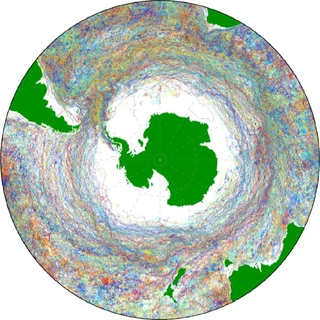
Lagrangian analysis is a powerful way to analyse the output of ocean circulation models and other ocean velocity data such as from altimetry. In the Lagrangian approach, large sets of virtual particles are integrated within the three-dimensional, time-evolving velocity fields. Over several decades, a variety of tools and methods for this purpose have emerged. Here, we review the state of the art in the field of Lagrangian analysis of ocean velocity data, starting from a fundamental kinematic framework and with a focus on large-scale open ocean applications. Beyond the use of explicit velocity fields, we consider the influence of unresolved physics and dynamics on particle trajectories. We comprehensively list and discuss the tools currently available for tracking virtual particles. We then showcase some of the innovative applications of trajectory data, and conclude with some open questions and an outlook. The overall goal of this review paper is to reconcile some of the different techniques and methods in Lagrangian ocean analysis, while recognising the rich diversity of codes that have and continue to emerge, and the challenges of the coming age of petascale computing.
Type
Publication
Ocean Modelling
